22 June 2025


10 June 2025
09 June 2025
Merch

I have opened a merch store. You can buy shirts with my logo, as well as shirts promoting the inclusive mission of The Game Dork's Gaming Corner: Everyone is welcome at the gaming table!
You can head over to the store front to peruse the options yourself, or you can see the available items below.
17 February 2025
26 January 2025
The Triumphant Return of The Game Dork!
It's been several years since I posted regularly. During that time, I developed a small following on TikTok. It has rekindled my love of talking about games and sharing new games, so I'm going to start posting again.
However, I'm going to shift to a video-based format. So when I post here, it will always be a link to a video I've uploaded to my YouTube channel.
So here's the first one: the first installment in my '60 Second RPG Reviews.' Surprising no one, it's an overview of Changeling: The Dreaming.
Enjoy!
14 March 2022
Free Roleplaying Games

I have been engaged in a debate on social media about whether it's acceptable to refuse to try any roleplaying game that isn't Dungeons & Dragons. One of the arguments that I keep hearing people make is 'I'm poor, and roleplaying games are expensive.'
This is a valid point, but I have a solution.
Ok, I have a solution and a comment. First, the comment: Hasbro has worked very hard to make people believe that you have to have every book in order to play (and more to the point, that each player needs a copy of the Player's Handbook, at the very least) in order to take full advantage of Dungeons & Dragons. That is very much not true. Most games work just fine if all you have is a single copy of the core rules. Supplements are optional, and in some circumstances, it's annoying to share a single rulebook (I remember trying to level up a character in D&D 3.5 when sharing a single copy of the Player's Handbook, and it was a challenge to say the least), but many games don't require the rulebook as much when advancing characters.
But now, on to the solution. There are a ton of free roleplaying games out there. Let's talk about some of them.
23 November 2021
RPG Review: Overlight

Almost two years ago, I discovered a roleplaying game that very much caught my attention. I bought it as soon as I was able, and I have not regretted doing so. Now, I am delighted to write a review for this game. Welcome, my friends, to Overlight from Renegade Game Studios.
An Overview of Overlight
Three thousand years ago, the guardian dragons that watched over the world debated whether humanity had earned the right to receive the eight keys to creation. Seven of the eight dragons voted 'no,' but the eighth dragon disagreed so strongly that he gave the keys to the humans in secret. When he did so, he warned them not to use the eighth key.
This was a mistake.
The humans used the eighth key, and the world was turned upside down. It shattered into seven shards, which are suspended in space above the Endless Sea, as the Overlight shines down from above. Each shard is home to a different species, and is characterised by different dominant terrain types.
Now, the ancient history has been lost, and none remember the world as it once was. But there are some, known as the Skyborn, who have an unusual relation with the Overlight. They are able to refract it into different colours, known as 'Chroma,' which they can manifest in wonderous magical effects.
Players take on the role of one of these Skyborn, and travel among the shards, trying to learn the truth of the world that has been lost to time.
First Point: Production Value
The book is beautiful. All the art was created by Kwanchai Moriya, and it is fantastic. It is colourful and whimsical, but with a hint of danger, which is fully in keeping with the game's theme. The right edges of the odd-numbered pages have coloured triangles to make it easier to navigate between chapters.
My biggest gripe with the production is that it could be a little more accessible to vision-impaired people. The text is in a serif-font, except the section headings, which are sans-serif. Most text is black on a pale lavender. The exceptions are: the chapter on the different shards (the background is a different colour for each shard, though the background is still a very light shade), section headings (which are still on a pale lavender background, but are red or purple instead of black), and sidebars (which are on pale green backgrounds). These are not huge issues for the visually impaired, but they are issues.
Apart from that, the only complaint I have is that there is no image I could find of the Brendenol Tribe of the Banyari. As they are the most unique of the Banyari tribes in appearance, an illustration would have been nice.
Second Point: Setting

The world of Overlight is very different from ours. There is no sky above, only the constant shine of the Overlight itself. There is no sun, no moon, and the only stars are the ones that appear to shine in the Endless Sea that lies beneath the shards. This means that the topmost shard, Nova, never has any darkness. It is a sprawling desert with little shade, populated by the Novapendra: giant centipede-like creatures (which are the only sentient race in Overlight that are not available as a PC race).
Lower shards have 'night' periods resulting from the shadows of higher shards passing over them, which happens sporadically, as the shards float around in a complex pattern that only the most learned of scholars understand. The second shard, Zenith, has few periods of darkness, because there's only one shard above it. Zenith is a cold place of snowy mountains. It is populated by the Hamanu, giant ape-like creatures, and the Zenith Order Monks (who are technically the same species as the Harkeen, but the rules treat them as a separate race).
Below that is Quill, a lush land of jungles and rivers. Many years ago, Quill collided with Banyan, the shard below it, and shattered into many smaller chunks. Quill is home to the Teryxians, feathered dinosaur-like creatures who value learning and stoicism (despite their impassioned hatred of the Banyari). Banyan, meanwhile, is a land of forest, and the Banyari who live there are small furry creatures who are divided into six tribes. Each tribe has a different appearance, but most of them have a symbiotic relationship with a plant that grows around them and forms a sort of living wooden power suit.
The next shard is Hark. Whatever terrain it once had has been subsumed by the city, also called Hark, which covers the entire continent. It is a multi-layered affair, as the city was created by digging into the bedrock to carve the houses and other buildings directly into the shard itself. It is home to the Harkeen, who are basically humans. Also on Hark is the Council of Seven, representatives from all seven of the shards that serves as a de facto government for the world.
Below Hark is Veile, made up of rolling hills and lush fields punctuated by lakes. The Aurumel call this shard home; they are similar to the Harkeen, but taller, slender, and never seen without their masks. They are renowned craftsmen and artists.
The lowest shard is Pyre. It is a hard land of mountains and volcanoes. As the lowest shard, it is most prone to being in darkness as the other shards float above it, blocking out the Overlight from above. The Pyroi call this place home, and the difficult life that they eke out in the rocky terrain leads them to value strength and endurance. They are a warrior culture, as it is hard enough to survive as warriors on their hard and hot shard. They are massive, taller even than the Hamanu, with dark skin that sometimes tends towards red, two fingers and a thumb on each hand, and elephant feet.
There is so much more that can be said about the setting. It is one of the things I love about this game; the world itself is so vibrant, so unique, and so rich in unusual details that it would take a long time to describe it in any real depth.
 |
| The various races from Overlight. |
Third Point: System
Core Mechanic
Characters do not have attributes. Instead, they have seven Virtues: Might, Vigor, Will, Compassion, Logic, Wisdom, and Spirit. These virtues function very similarly to attributes, though there are some ways in which they are less intuitive than attributes. Each Virtue is rated on a step scale: D6, D8, D10, or D12.
Each Virtue has three skills associated with it (except Might, which has only two, and Spirit, which works differently from the others). These skills are rated on the same step scale of D6 to D12 as the Virtues.
To make a roll, you take three of the dice rated for your Skill and three of the dice rated for the controlling Virtue, plus 1d4 to serve as the Spirit Die, and roll all of them together. Every two dice that come up as 6 or higher counts as a success level. For example, imagine that you were rolling your Persuasion, which was rated at D8, and was governed by the Will Virtue, which was rated at D10. In this case, you would roll 3d8 + 3d10 + 1d4. If two of those dice come up as 6 or higher, that's the basic level of success: Luminous Success. If four of those dice land on 6 or more, you have achieved the second level of success: Radiant. If all six dice results are 6 or higher, that's the third level of success: Brilliant.
The Spirit Die is a little different. Since it can't land on 6, it serves an auxiliary function. If the Spirit Die lands on 4, it will have different effects in different situations. If you are one die short of the next higher success level, it bumps you up to that level. If you score a Brilliant Success and the Spirit Die lands on 4, it promotes the success to the highest level: Legendary. Otherwise, it grants you a Spirit Point. Spirit Points can be spent in various ways, most often to fuel Chroma or to upgrade a success to the next highest level.
Keep in mind, this is just how skill rolls work. The system is slightly different if you're rolling to use a Chroma, making an opposed roll, rolling to attack in combat, or (and this is weird, because money is abstracted in Overlight) making a 'Wealth Test' to see if you can afford a purchase.
This is honestly my biggest concern about this game. As much as I love basically everything else about it, the core mechanic is so complicated and overwrought that it detracts from what is otherwise a nearly perfect game for me. Not only is it hard to remember how the different types of die rolls work, and the different functions of the Spirit Die in each different type of roll, but you need a lot of dice. At a minimum, you need a d4, 3d6, 3d8, 3d10, and 3d12 (if you're willing to roll a set of dice twice if the skill and Virtue have the same rating). Ideally, there'll be 1d4, 6d6, 6d8, 6d10, and 6d12, if all players share the dice. But 25 dice for one game is a bit extreme.
Chroma
The 'magic' in Overlight is called 'Chroma.' These are basically spell lists, but you're only allowed to take Chroma that are associated with your race or your core Virtue. As much as this game purports to be about characters who are remarkable when compared to the 'normal' denizens of their world, the Chroma don't seem terribly powerful to me. Also, given that the Chroma are powered by Spirit Points, which can be hard to come by, I wonder if it can be difficult to use the powers you do have.
Combat
This is the area in which most people are turned off by this game. Combat is highly abstracted. There is usually no defense roll (unless you spend a Spirit Point to take the Full Defense Manoeuvre, which entails forgoing your attack on that turn). There are no damage ratings for different attacks or different weapons; regardless of whether you are punching, kicking, biting, attacking with a sword, spear, arrow, or thrown rocks, you do the same amount of damage (which is determined by the number of dice that come up as 6 or higher on your attack roll).
The rules state that the focus of this game is storytelling, and they don't want that impeded by lengthy combats full or constant dice rolling. Which is fine for players like me, who are more interested in the story anyway, but for players who demand lots of tactics and detailed combat systems, it is a serious drawback. I have heard more than one player look at this game and say something like, 'I was interested until I read the combat rules, then I decided I had no desire to play.'
Final Thoughts on Overlight
I know that not everyone is going to be interested in this game. For many players, it's not fighty enough. For others, the overwrought core mechanic is too hard to get past. And for some, the setting is just too different.
But despite the core mechanic not being to my liking, I am a big fan of the game. Much like my affection for The Dark Crystal, the world is so unique, so different, so creative, so innovative, that I can overlook the things I don't like about it. I love exploring new and different settings, especially when we have a fantasy setting that doesn't follow the usual elves/dwarves/goblins/etc pattern.
If this sounds interesting to you too, you can head over to the Renegade Studios website and take a look at what they have. Until next time,
Game on!
14 October 2021
A Scale for Crunchiness in RPGs?
Have I come back from hiatus?
No. No, I don't think so.
However, after writing the last two articles (review of Modiphius's two new rpgs), I found that I have some things I want to say. So I'm going to write a couple more articles, and then probably go radio silent again for... who knows how long?

To start with, I was thinking about crunchiness in rpgs. I started really thinking about it when I was reading the Fallout rulebook, and wanted to compare its crunchiness level to other games.
What is crunchiness, you may ask? Let me explain.
Or rather, let me describe the quivering morass that is people's differing opinions on what crunchiness is.
18 September 2021
RPG Review - Fallout: The Roleplaying Game
Last week, I emerged from my hiatus to post a review of a game that was generally sent to me by the publisher. But they were kind enough to send me two games to review, so today, I shall review the second of those games.
So welcome, fellow gamers, to my review of Fallout: The Roleplaying Game.

I should take a moment here to point out that when you look on RPG Geek, this game is listed as 'Fallout 2d20.' Don't make the mistake of looking at 'The Fallout Roleplaying Game;' that appears to be a homebrew D20 version. This is the official licensed version.
11 September 2021
RPG Review - Dune: Adventures in the Imperium
It has been over a year since I last posted anything. But I return to you today with a very important post: a review of a new TTRPG.
I was recently contacted by a representative of Modiphius Entertainment asking me if I'd like some advanced review copies of their forthcoming games. Obviously, I jumped at the chance. So they generously sent me a review copy, which I will now review for you.

An Overview of Dune: Adventures in the Imperium
Modiphius returns to their 2d20 system for this outing into the world of Frank Herbert's sci-fi books. Although the rules can be used to play in any era of the saga, the core rulebook focuses primarily on the end of the Imperium era; that is, the rise of Paul Atreides. The game is clearly published as a tie-in with the Denis Villeneuve film, but can easily work for those who are more familiar with the books. Although there are plenty of rules for combat, the game is intended for a more narrative style of gaming that is in keeping with the epic 'galactic politics and intrigue' style of story that fits in with the books.
07 March 2020
The End (For Now, At Least)

The time has come for me to take a break. After this article, I will be going on an indefinite hiatus.
There are a number of reasons for this decision. Not least among those is the fact that I am not gaining any dedicated repeat readership. Despite my best efforts, the number of people who come back to read my posts every week remains a very small number. Barely in the double digits.
Additionally, there's the matter of time. My work as a middle school teacher takes up a vast quantity of time. I had been doing my best to carve what time I could in the evenings or weekends to write articles, take photos for game reviews, research market trends, etc. But I'm finding that I just don't have the time for it all. It's been a long time since I've been able to do any 'how to play' videos, which is frustrating to me, as there are a lot of games out there that need better tutorial videos. I know I'm no cinematic master, but at least (in my opinion) the videos I make are made in a more intuitive format than many of the ones I've seen out there.
29 February 2020
Board Game Review: Underwater Cities

John can be very impulsive sometimes. One day, he showed up to our usual Friday night game night with a new game that he'd seen at the FLGS and bought immediately because he thought it looked interesting.
Well, we played it that night, and again a couple weeks later. The game in question was (of course) Underwater Cities by Vladimir Suchy from Rio Grande Games. It turned out to be an interesting fusion of worker placement, economic development, and resource management. Normally, these are three game mechanics for which I don't care. But oddly enough, this game combined them in a way that made me not hate it.
But I'm getting ahead of myself. Let's do this properly, shall we? Here are the numbers:
22 February 2020
The Appeal of Board Games

Not too long ago, I published an article in which I referenced an ex-girlfriend who once told me that I think too much. Specifically, it was in the context of a comparison of casinos to board game cafes, and the differences between board games and gambling. I was reminded of this by two events that recently happened: I attended a friend's party, and a different friend sent me a link to an article about how board games can reduce cognitive decline in old age.
The article does not mention the reason why board games are so beneficial to mental fortitude; it quotes the author of a scientific study as saying 'it is not just general intellectual and social activity, it seems; it is something in this group of games that has this small but detectable association with better cognitive ageing.' Which implies that they don't claim to know why board games improve cognitive function in the elderly.
Sure, I'm no scientist, but I have a pretty good idea what it is about board games that make them so beneficial. Two factors: social interaction and mental engagement.
15 February 2020
Board Game Review: Draftosaurus
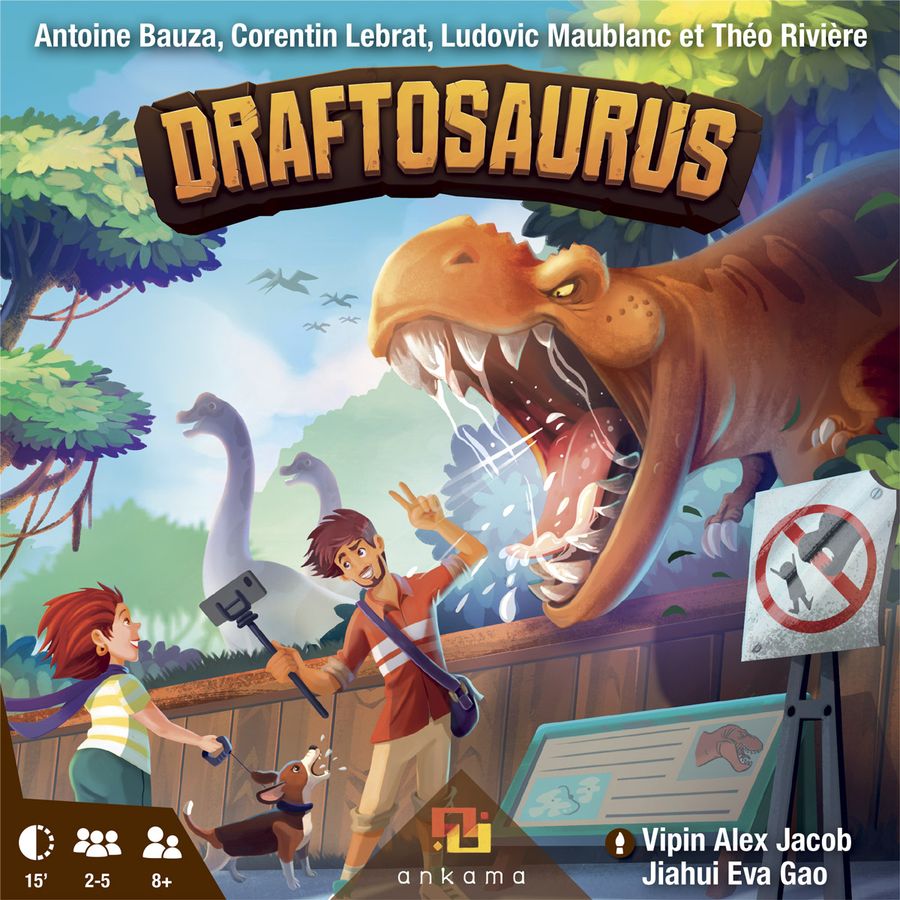
If you're looking for an adorable variant on a card-drafting mechanic, then look no further. Draftosaurus by Antoine Bauza, Corentin Lebrat, Ludovic Maublanc, and Théo Rivière, published by Ankama, is a very simple card drafting game, but instead of drafting cards, you're drafting dinosaurs!
Players take on the role of zookeepers looking to populate their parks with newly cloned dinosaurs. Each player wants to get the best combination of dinosaurs possible to make their dino-zoo more interesting to patrons than the other parks' owners.
Before we get any further, let's take a look at our numbers:
08 February 2020
Ten Candles: A Unique Roleplaying Experience

I recently watched an interesting video entitled '10 Great RPGs That Aren't Dungeons and Dragons.' That was how I learned about Ten Candles, a zero-prep one-shot roleplaying game by Stephen Dewey and published by Cavalry Games. It sounded interesting, so I read the description to the Dork Spouse, who expressed immediate interest.
After purchasing a copy of the rules, I called up a couple of friends (who were suggested by the Dork Spouse), and we all arranged to play a game together. So we sat down to tell the tale of a quartet of doomed individuals, trying to escape from an airport during the end of the world. I later ran some other games for other groups, and now I would like to share my experiences with you.
Ten Candles is somewhere between a normal RPG, like Fate or GURPS, and the one-shot mostly-free-form storytelling venture that is Fiasco. Unlike Fiasco, there is a GM, and dice rolls are still used to determine success or failure, but more in the style of Fiasco, it takes place in a single session, and the goal is less about succeeding in a mission and more about telling a great story.
An Overview of Ten Candles
The GM chooses a module (there's no reason you couldn't also create one yourself). That's the extent of preparation. Then you sit down around a table with some friends and create characters. This is done with index cards; each character gets a virtue (a single word describing some positive characteristic), a vice (a single word describing a negative feature), a moment (something that could potentially happen to bring your character hope), and a brink (some unsavory or unethical thing that your character has done in the past, and that you are likely to do again in a dark moment). Each of these is written on a different card.Then the players record a final message (in the style of 'whoever finds this message, I want you to know that we tried'). All lights are extinguished except for the ten candles in the centre of the table, and play begins.
 |
| The candles which give the game its name, and which serve as an important part of the game's core mechanic. |
They are nebulous and ambiguous. The GM can't even make any decisions about who or what They are before the game begins, because the players influence what They are, how They behave, and what They are able to do. They change each game, and not even the GM knows exactly what they are until the game is underway (sometimes even later).
The one thing that is always true about Them is that They avoid the light. So long as you stay in the light, you're safe.
But after five days of burning through power reserves, the world's generators are blown out. Power failures are occurring with increasing rapidity. Your characters are in a safe place for the moment, but the lights are going to go soon. Whatever the goal of the chosen module is, you have to try to accomplish it whilst there's still time.
But here's the thing: Ten Candles is a game of tragic horror. Horror, because it's frightening. Tragic, because your characters are going to die.
The game always ends with every character dying.
At the end, after telling a story of tragic heroism, of struggling against the dying of the light only to die along with that light, the players listen to the recording they made at the beginning of the game. They then sit back and enjoy the tale they have told together.
Some Detail
Players roll a number of six-sided dice to accomplish any task or attempt to be successful in any sort of conflict. If any of those dice result in a six, the task is successful. If none result in a six, then not only does the task fail, but the scene ends, a candle is extinguished, the dice pool is reduced by one, and players undergo a brief ritual in which they 'establish truths;' that is, they make a single statement about the world that must be accepted by all players (including the GM) as truth. This can be as simple as 'we found our way to the house', or as grandiose as 'the government created Them as genetically engineered monsters to serve as soldiers.' Then play continues in the next scene.
Once a candle goes out, it may not be reignited. Whether this is intentional (as the result of a failed die roll) or accidental (someone sighed heavily and blew a candle out), it brings the players one step closer to the end.
In most cases, some dice can be rerolled by burning one of the cards that contain your character's virtue, vice, moment, or brink, and when you burn your moment, you may gain a hope die which is more powerful than a regular die. But generally, it's a simple case of 'roll all the dice and hope that at least one lands on six.'
Additionally, when a roll is successful, it will often be the player, rather than the GM, who narrates the outcome of that roll. This gives the players greater control over the game than in most RPGs.
The Games We Played
In my first game, the Dork Spouse and I sat down with three of our friends to tell the tale of three people and a service dog trapped in Terminal A of an airport, after seeing Terminals B and C go dark. Then a voice over the intercom announced that there was a plane at Terminal D that would take off in three hours.
A curmudgeonly old man, a flight attendant, and a greedy head of a non-profit organisation joined forces (along with the dog, who's human had vanished before the game began), to find a runway service truck they could drive to Terminal D. There, they found some more survivors and boarded the plane just before the lights went out in the terminal right before taking off. Afterwards, an argument amongst the passengers escalated until a fire broke out in the plane's cabin. The last surviving PC died in the ensuing crash.
All the players enjoyed the game. They said it was an interesting experience to play a game they knew from the beginning they weren't going to 'win.' And knowing that the characters were going to die allowed them to really explore their personalities.
The second game was about a group of former sorority sisters getting together at Christmas in an isolated rented mansion in upstate New York and trying to survive when cut off from civilisation. The third game was about people who had just moved to a new city to make a fresh start in life and were staying in a hostel as they try to find a permanent home when the lights went out. In that game, they had learned that there was an arena across town that was being set up as a refuge, and the local schools were operating as waystations, and all they had to do was find a way to make it there.
The second game was about a group of former sorority sisters getting together at Christmas in an isolated rented mansion in upstate New York and trying to survive when cut off from civilisation. The third game was about people who had just moved to a new city to make a fresh start in life and were staying in a hostel as they try to find a permanent home when the lights went out. In that game, they had learned that there was an arena across town that was being set up as a refuge, and the local schools were operating as waystations, and all they had to do was find a way to make it there.
The Point of Ten Candles
Obviously, that's a double-meaning expression. On one hand, the point of Ten Candles is to tell a great story. But the larger question: 'what's the point in playing a game in which you know before you even begin that your character is going to die? You can't win, so why bother playing at all?'
You may as well have asked why members of Star Fleet take the Kobayashi Maru test. It's not about winning. It's about what you learn from the experience.
From the rulebook:
It is a game about loss, but it is also a game about hope. Through it all, you must remember this: Though your characters will die, you must have hope that they will survive. That hope will live on, even in the end. But hope can be lost when those who guard it are pushed to the edge. It is in those moments that the darkness around becomes the darkness within, and that is when They have truly won.
And that, I think, is the real 'point' of Ten Candles. By telling stories in darkness, we strengthen the light. By playing games of fear, we reinforce our own strength. Or, to put it another way (and in the words of G.K. Chesterton), 'Fairy tales do not tell children the dragons exist. Children already know that dragons exist. Fairy tales tell children the dragons can be killed.'
Ten Candles is not about telling stories in which there is no hope. It is about telling stories in which, in the end, hope is all that's left.
So that's my impression of Ten Candles. I recommend you give it a try! Until next week, remember as always to
Ten Candles is not about telling stories in which there is no hope. It is about telling stories in which, in the end, hope is all that's left.
So that's my impression of Ten Candles. I recommend you give it a try! Until next week, remember as always to
Game on!
01 February 2020
Board Game Review: Multiuniversum

John found a game that he really enjoyed when we went to Geekway to the West last year. It's called Multiuniversum, and it was designed by Manuel Correia. It was originally published by Board & Dice, with a second edition published by Last Level, and the current edition is from Grey Fox.
The premise is that scientists working on creating portals to alternate universes have succeeded in creating those portals, but now must shut them down before horrors from those other universes emerge into ours. You score points by closing portals, as well as gaining bonus points, set-collection style, by gathering data from the universes as you shut down the portals.
Let's take a look at this little game, shall we?
25 January 2020
Spoilers, Rage, and Toxic Fandom

Several months ago, The Dark Crystal: Age of Resistance was released on Netflix. Obviously, I binged it the very next day. And loved it. As I'm sure you can tell from the review I wrote of it.
I'm sure it will come as no surprise to you that I had been a member of the 'Age of Resistance Fan Group' on Facebook leading up to the release. I found it a convenient place to keep up with news, see stills and trailers in advance of the series, and geek out with fellow aficionados.
What was very disappointing to me, however, was how volatile and antagonistic that group became after the show was released.
Some people were unable or unwilling to binge the entire season in one sitting. These people asked for others to put spoiler warnings on posts that contained spoilers. And much to my surprise, there was a large and very vocal contingent of fans that absolutely and vociferously refused.
18 January 2020
Board Game Review: Blokus

In the midst of the revolution in which a number of amazing companies produce some amazing new games and many small companies produce many more amazing games, it's easy to scoff at the large 'mainstream' companies who continue making games which are intended to appeal to the general public instead of the board game community. But that doesn't mean that some of their games aren't really good.
This is the case with Blokus (pronounced BLOCK-us), created by Bernard Tavitian and published by Mattel. Though it bills itself as a family game, it holds a surprising level of depth and strategy. It is a refreshingly thinky game that is easy to learn and play, but contains intense tactical challenges.
But let's not get ahead of ourselves! We'll start as we always do, with the numbers:
Subscribe to:
Posts (Atom)


 Posts

